Best Rocoto Relleno Near Me: Dublin & Peru Top Spots
If you’ve ever wandered through Exchequer Street wondering where to get a proper rocoto relleno in Dublin, you’re not alone. This fiery Arequipa classic—stuffed peppers with a savory filling that runs from cheese to steak—rarely shows up on Irish menus, even at Peruvian-inspired spots that otherwise nail ceviche. The good news: the gap tells you exactly where to set expectations.
Origin City: Arequipa, Peru ·
Top Dublin Spot: Cantina Valentina ·
Key Stuffing: Minced meat ·
National Dish Alternative: Ceviche ·
Recommended Picanteria: La Nueva Palomino
Quick snapshot
- Rocoto Relleno originates from Arequipa, Peru (Expat Chronicles food guide)
- Cantina Valentina operates at 1-5 Exchequer Street, Dublin (Eat Peru Dublin restaurant guide)
- Which Dublin restaurants have added rocoto relleno to their menus since 2020
- Whether current Dublin Peruvian spots source authentic rocoto peppers
- Zampas opened at Hard Rock Hotel in early 2020, marking Dublin’s Peruvian-Irish fusion wave (Eat Peru Dublin restaurant guide)
- Travelers to Peru can benchmark Arequipa picanterías against any Dublin finds
The table below consolidates verified location and pricing data from Arequipa benchmark restaurants and Dublin Peruvian options.
| Detail | Value |
|---|---|
| Dublin Location | 1-5 Exchequer Street |
| Arequipa Top Pick | La Nueva Palomino |
| Peru National Dish | Ceviche |
| Picanteria Options | La Capitana, Yanahuara |
What is rocoto relleno in English?
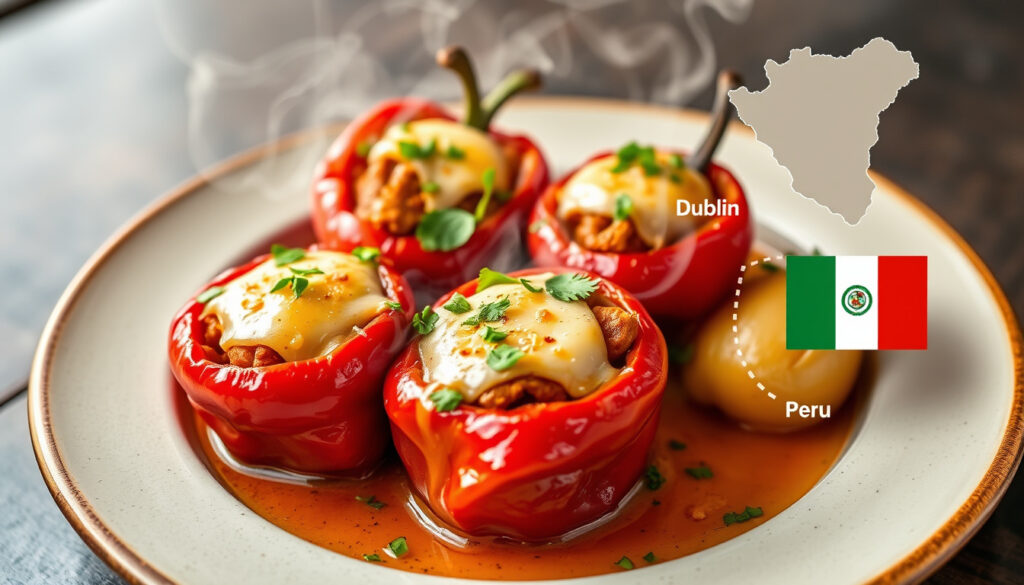
Rocoto Relleno translates roughly to “stuffed rocoto pepper”—a Peruvian take on the stuffed pepper concept, but with a distinct local character. The rocoto pepper itself sets this dish apart from the bell peppers you’d find in most other cuisines: it’s smaller, rounder, and carries a heat that Arequipa locals have learned to respect for centuries.
Origin and description
Rocoto Relleno is the signature dish of Arequipa, made with spicy rocoto peppers stuffed with a mixture that typically includes steak, cheese, olives, peanuts, spices, and sometimes raisins, then baked until the filling sets and the pepper softens (Expat Chronicles Arequipa food guide). The dish arrives at the table with a crown of pastel de papa—a layered potato casserole—often pooling in the same plate in what locals call combination doubles or triples.
The preparation alone separates this from standard stuffed peppers. Rocoto peppers are de-seeded, de-stemmed, and boiled before stuffing to mellow their bite, then baked until the cheese inside begins to ooze. “The signature dish and source of Arequipeño pride is Rocoto Relleno,” notes one food chronicler covering the region (Expat Chronicles Arequipa food guide). The pepper’s shape, color, and size distinguish it from other Peruvian varieties in ways that locals notice immediately.
Key ingredients
The stuffing base varies by picantería, but ground or minced meat forms the anchor. Arequipa establishments like Sol de Mayo and Ary Quepay build their version around steak cut into small pieces, combined with cheese, olives, peanuts, and a spiced binding (Peru Explorer Arequipa restaurant guide). The result is a dish that balances heat, saltiness, and a subtle sweetness from optional raisins—something that takes patience to get right.
Dublin Peruvian restaurants have focused heavily on ceviche, but rocoto relleno requires entirely different sourcing and technique. Travelers who’ve tried the Arequipa original often notice the gap immediately.
What kind of meat is in Rocoto Relleno?
The traditional filling leans toward minced or ground meat—beef in most Arequipa preparations, though some picanterías use pork or a mix. The meat typically gets seasoned with cumin and other spices before combining with the cheese, olives, and peanuts that give the dish its characteristic richness.
Traditional filling
According to Arequipa restaurant guides and customer reviews, the standard rocoto relleno stuffing starts with steak or minced beef as its protein base (Peru Explorer Arequipa restaurant guide). At Tipika Tourist Restaurant—a spot consistently praised for its rocoto relleno—diners report a generous portion of meat alongside the cheese and accompaniments (Tipika Tourist Restaurant TripAdvisor reviews). The combination makes the dish hearty enough to function as a full meal rather than an appetizer.
Variations
Not every picantería approaches the filling the same way. Some Arequipa spots add raisins for sweetness, while others keep the filling savory-focused with more peanuts for texture. A few establishments experiment with different cheese types—queso fresco versus harder local varieties—affecting both flavor and how the filling binds during baking. TripAdvisor reviewers at La Capitana noted receiving the rocoto relleno alongside pastel de papa and chupe de camarones in an authentic setting, suggesting that side pairings matter as much as the stuffing itself (La Capitana TripAdvisor reviews).
What is the world’s number one restaurant in Peru?
Peru’s culinary scene has attracted international attention that extends well beyond rocoto relleno. The country has seen several restaurants earn global recognition, with Central in Lima consistently ranked among the world’s best by organisations that track fine dining across multiple countries.
Top ranked spots
Central Restaurante in Lima has claimed top positions on World’s 50 Best Restaurants lists in recent years, placing Peru firmly on the global gastronomic map. Mind-blowing fusion describes the approach at several Lima establishments—places that weave Peruvian ingredients through techniques borrowed from Japanese, Chinese, and Mediterranean traditions. One review from the Ottawa Citizen described the country’s culinary rise as transformative, with chefs like Gastón Acurio helping shift Peru’s food reputation internationally (Peru Explorer Arequipa restaurant guide).
Fusion options
Arequipa offers its own fusion takes. Chicha by Gastón Acurio in Arequipa provides a refined option that runs $15-20, representing the fine-dining end of the local spectrum compared to casual picanterías at $5-15 price points (Peru Explorer Arequipa restaurant guide). The gap between a $5 rocoto relleno at a neighborhood picantería and a $20 tasting menu at an internationally recognized spot illustrates Peru’s culinary range in concrete terms.
None of the top-ranked Peruvian restaurants specialize specifically in rocoto relleno—the dish belongs more to the Arequipa picantería tradition than to Lima’s fine-dining establishments.
Is there a Michelin star restaurant in Peru?
Michelin’s coverage doesn’t extend to Peru as a market—the guide hasn’t expanded its star system to cover Lima or any other Peruvian city. However, this absence of Michelin stars doesn’t reflect any gap in quality. Peru’s top restaurants operate at levels that many Michelin-starred establishments globally would recognize.
Michelin presence
Michelin currently publishes guides covering destinations in Europe, North America, and parts of Asia, but not South America. Travelers hoping to find a Michelin-starred restaurant in Peru will need to adjust expectations accordingly. The lack of Michelin coverage doesn’t diminish what establishments like Central or Maido achieve—it simply reflects the guide’s current geographic limitations.
High-end dining
Without Michelin stars to reference, visitors can look to other quality signals. World’s 50 Best Restaurants rankings have consistently featured Peruvian establishments, with Central maintaining its position near the top for multiple consecutive years (Peru Explorer Arequipa restaurant guide). The 50 Best framework functions as a de facto alternative to Michelin in regions the French guide hasn’t reached.
How much is a fancy dinner in Peru?
A fancy dinner in Peru spans a wide range depending on city and venue type. Arequipa’s fine-dining options like Chicha by Gastón Acurio typically run $15-20 per main, while Lima’s top restaurants can command significantly more for multi-course tasting menus.
Budget estimates
For travelers budgeting a Peru trip, Arequipa picanterías offer authentic rocoto relleno at casual prices—typically $5-15 at spots like Ary Quepay and Sol de Mayo (Peru Explorer Arequipa restaurant guide). Stepping up to fine-dining in the same city adds roughly 50-100% to the bill. A three-course meal at a mid-range Lima restaurant generally costs less than half what a comparable meal would run in Dublin or London.
Travel costs 2026
Travelers heading to Peru in 2026 should factor in exchange rate advantages for visitors from Ireland or the United States. The Peruvian sol remains considerably weaker than the euro or dollar, meaning that even upscale dining represents strong value. A $20 dinner in Arequipa translates to roughly €18-19 at current rates—comparable to a casual restaurant meal in Dublin. The practical implication: travelers can eat well at authentic Arequipa picanterías for prices that would buy fast food back home.
Irish travelers visiting Arequipa find the local dining scene remarkably affordable by European standards. A $5-15 rocoto relleno at a traditional picantería costs roughly one-fifth what a comparable dish would price at an upscale Dublin restaurant.
Upsides
- Arequipa picanterías serve authentic rocoto relleno at $5-15, representing excellent value by international standards
- Dublin’s Peruvian scene has grown since 2020, with spots like Cantina Valentina and Zampas offering Peruvian-inspired cooking
- Travelers can benchmark any Dublin finds against established Arequipa standards at La Capitana, Tipika, and La Nueva Palomino
- Peru’s culinary reputation has grown globally, meaning more English-language resources exist for planning meals
Downsides
- No Dublin restaurant has explicitly confirmed serving authentic Arequipa-style rocoto relleno as of current reporting
- Dublin Peruvian spots focus heavily on ceviche and other coastal dishes rather than Arequipa-specific fare
- Zampas uses 100% Irish ingredients, which may dilute authenticity for travelers expecting traditional preparation
- Michelin doesn’t cover Peru, so visitors can’t rely on familiar quality signals when choosing restaurants
Peru dining etiquette and first-timer guide
Understanding how Peruvians approach dining helps travelers navigate picanterías and fine-dining rooms alike. The norms differ from Irish restaurant culture in ways that affect both the experience and the budget.
What to expect at Arequipa picanterías
Picanterías operate differently from Western restaurants. These casual establishments often serve set menus or combination plates, with rocoto relleno paired with pastel de papa and sometimes pork in what locals call doubles or triples. Portions tend toward generosity—”The food was very good, size above average,” noted one TripAdvisor reviewer at La Capitana (La Capitana TripAdvisor reviews). Tipping follows local norms: a 10% service charge often appears on bills, and additional tip is optional rather than expected.
Etiquette considerations
Leaving food on your plate in Peru can carry cultural weight. “Is it rude to not finish food in Peru?” ranks among the common travel questions, and the answer generally leans toward yes—waste is viewed negatively in a country where many households still struggle with food security. Travelers should order conservatively and share plates where possible. The good news: combination plates at picanterías make portion control easier, since the server can suggest sizes based on your appetite and group size.
We ordered Rocoto Relleno, Pastel de Papa and Chupe de Camarones. The food was delicious and the atmosphere of the place was very authentic.
— Tripadvisor Reviewer, La Capitana Arequipa
Tipika is a great restaurant for traditional Arequipa dishes… Best Rocoto Relleno.
— Peru Explorer food critic, Tipika Tourist Restaurant
Uber Eats results for “Peruvian food delivery Dublin” actually return listings for Dublin, Ohio—not Ireland. Travelers frustrated by delivery app results should verify they’re searching Dublin, Ireland specifically.
Related Peruvian dishes to try in Dublin
While rocoto relleno remains elusive on Dublin menus, several other Peruvian dishes have established footholds in the city that offer a sense of the cuisine’s range.
Ceviche and coastal options
Dublin’s Peruvian restaurants have focused heavily on ceviche—the raw fish cured in citrus that’s Peru’s national dish. Cantina Valentina offers Peruvian-inspired preparations at its Exchequer Street location within The Hoxton hotel (Eat Peru Dublin restaurant guide). Zampas at the Hard Rock Hotel has built its menu around Peruvian dishes using Irish ingredients, with ceviche as a signature item (Eat Peru Dublin restaurant guide).
Other Peruvian options in Dublin
Taste at Rustic on South Great George’s Street serves papa a la huancaína, anticuchos, arroz con mariscos, and ceviche, but research hasn’t confirmed rocoto relleno on their menu (Eat Peru Dublin restaurant guide). Food trucks operating in Dublin offer takeaway versions of dishes like papa rellena, though again without rocoto relleno appearing in current sources.
The implication: Dublin diners seeking rocoto relleno face a genuine gap in the local market. The closest thing to an authentic Arequipa experience in Dublin involves visiting Cantina Valentina for general Peruvian-inspired cooking while understanding that the specific dish in question requires a trip to Peru—or at minimum, a flight to Lima and a domestic connection to Arequipa.
Related reading: Things to Do This Weekend Near Me
While Cantina Valentina shines in Dublin, the local rocoto relleno guide uncovers additional nearby spots and authentic recipes true to Arequipa’s spicy traditions.
Frequently asked questions
What is the national dish of Peru?
Ceviche—raw fish cured in citrus juice, typically lime or lemon—is widely considered Peru’s national dish. The preparation varies by coastal region, with Lima’s versions often featuring additional ingredients like red onion, cilantro, and ají peppers. Rocoto relleno, while iconic to Arequipa, occupies a regional rather than national status.
Is it rude to not finish food in Peru?
Yes, leaving significant food on your plate in Peru can be considered wasteful and potentially disrespectful to hosts or restaurant staff. The expectation stems from cultural attitudes toward food security rather than hospitality norms. Travelers should order portions thoughtfully or share dishes when uncertain about serving sizes.
What is the only 7 star restaurant in the world?
The concept of a “7 star restaurant” isn’t an official rating from any recognized guide. The label occasionally appears in marketing materials or informal media references, but no globally accepted restaurant rating system awards seven stars. Travelers seeking quality signals should rely on World’s 50 Best or Michelin coverage where available.
How much cash do I need for 10 days in Peru?
Budget estimates for 10 days in Peru vary significantly by travel style. Mid-range travelers might budget $60-100 per day including accommodation, meals, and activities. Arequipa picanterías keep food costs low at $5-15 per main, while Lima’s fine-dining scene commands premium prices. A reasonable total budget for 10 days falls in the $800-1500 range excluding flights.
Can girls wear shorts in Peru?
Yes, shorts are generally acceptable for women throughout Peru’s tourist areas and cities. Beach destinations like Mancora and Lima’s coastal zones see shorts as standard attire. However, conservative dress becomes more appropriate when visiting churches, traditional markets in highland communities, or rural areas where tourists remain uncommon.
More related posts
 Ayo Edebiri Movies and TV Shows: Complete Filmography
 Birthday Cakes Near Me: Supermarkets & Bakeries in Ireland
 Call of Duty Black Ops 6: Release, Price, Worth It Guide
 Where does Elon Musk live? Tiny home & Austin compound
 Denver Broncos vs 49ers Match Player Stats: Aug 9, 2025
 Los Tigres del Norte: Members, Deaths, Songs & Net Worth
 Who Is the President of the United States? (2025 Update)
 Type 1 Diabetes Symptoms: Early Signs in Kids and Adults