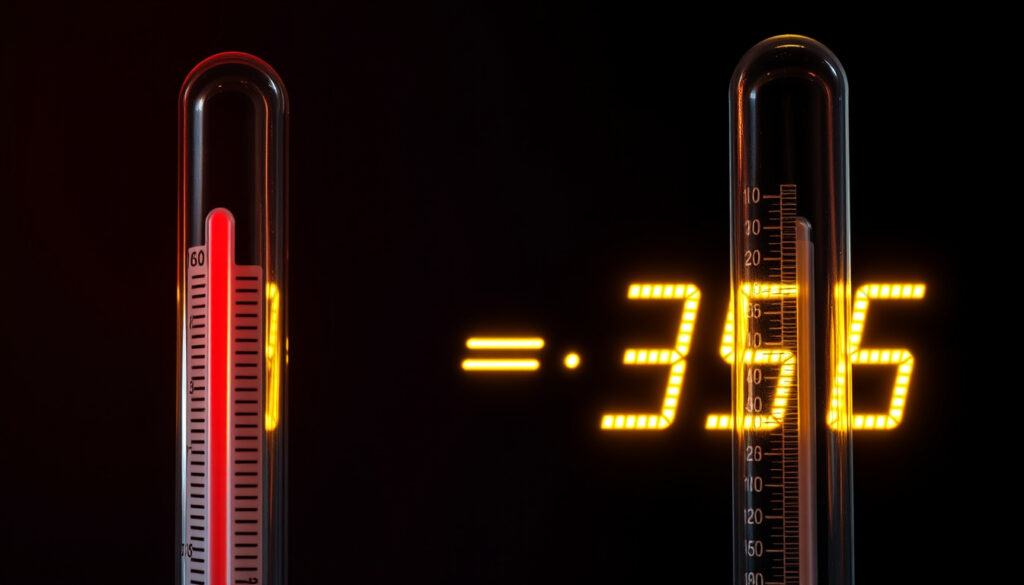
180 Celsius to Fahrenheit – Exact Conversion and Formula
Converting temperatures between Celsius and Fahrenheit comes up frequently in cooking, science, and everyday life. When the task involves translating 180 degrees Celsius into Fahrenheit, the answer is straightforward: 180°C equals exactly 356°F. This conversion follows a simple mathematical formula that has been standardized internationally for decades. Understanding how to perform this calculation yourself can eliminate the need for look-up tools in many situations.
The Celsius and Fahrenheit scales were developed independently, with the Celsius scale based on the properties of water and the Fahrenheit scale originally defined by salt mixtures and human body temperature. Despite their different reference points, the relationship between them can be expressed precisely using a single formula. This article explains that formula, walks through the calculation step by step, and provides practical context for why this particular conversion matters in real-world applications.
What Is 180°C in Fahrenheit?
The direct answer to the question of what 180 degrees Celsius equals in Fahrenheit is 356°F. This result is obtained by applying the standard conversion formula, which yields an exact value with no rounding required. The calculation works consistently regardless of the starting temperature.
356°F
(°C × 9/5) + 32
Moderate heat (350-360°F)
82.22°C
Several key insights emerge from this conversion. The calculation follows a precise mathematical relationship, ensuring consistent results every time. This temperature sits comfortably in the moderate oven range, making it one of the most commonly referenced conversions in recipes worldwide.
- 180°C converts to exactly 356°F using the standard formula
- The result requires no rounding or approximation
- This temperature represents a moderate oven setting ideal for baking
- The Fahrenheit scale uses different reference points than Celsius
- Understanding both scales helps when following international recipes
- The conversion factor (9/5) derives from the different size of each degree on the two scales
| Celsius (°C) | Fahrenheit (°F) | Context |
|---|---|---|
| 0 | 32 | Freezing point of water |
| 37 | 98.6 | Average human body temperature |
| 100 | 212 | Boiling point of water |
| 180 | 356 | Moderate oven temperature |
| 200 | 392 | Hot oven for roasting |
| 220 | 428 | Very hot oven |
How to Convert Celsius to Fahrenheit (Formula and Steps)
The formula for converting Celsius to Fahrenheit follows a specific mathematical relationship. To convert any temperature from Celsius to Fahrenheit, you multiply the Celsius value by 9, divide by 5, and then add 32. This can be expressed more concisely as (°C × 9/5) + 32, or equivalently as (°C × 1.8) + 32.
Understanding the Conversion Formula
The formula accounts for the different sizes of degrees on each scale. Between the freezing and boiling points of water, Celsius spans exactly 100 degrees while Fahrenheit spans 180 degrees. The ratio 180/100 reduces to 9/5, which represents the conversion factor. Adding 32 adjusts for the different starting points, since water freezes at 0°C but 32°F.
The conversion factor of 9/5 (or 1.8) ensures mathematical accuracy. Using either expression yields identical results, though (9/5) makes the relationship between the two scales more transparent.
Step-by-Step Calculation for 180°C
Breaking down the conversion for 180°C into individual steps clarifies the process. First, multiply 180 by 9 to get 1,620. Then divide 1,620 by 5 to obtain 324. Finally, add 32 to reach 356. Each step follows directly from the established formula.
For a faster estimate, double the Celsius temperature and add 30. For 180°C: 180 × 2 = 360, then 360 + 30 = 390, which is close to the exact value of 356°F. The approximation works best for cooking temperatures in the moderate-to-hot range.
The calculation can also be performed using the alternative expression °F = (°C × 1.8) + 32. Multiplying 180 by 1.8 directly yields 324, and adding 32 produces the same result of 356. Both approaches are mathematically equivalent and equally valid. Understanding both methods provides flexibility depending on what tools are available for calculation. NIST maintains detailed standards for temperature measurement conversions that establish these formulas as internationally recognized.
180°F Back to Celsius
Converting in the reverse direction follows the inverse mathematical operation. To convert Fahrenheit to Celsius, you subtract 32 from the Fahrenheit value, then multiply by 5/9. For 180°F, the calculation proceeds as follows: (180 – 32) × 5/9 = 148 × 5/9 = 82.22°C.
This reverse conversion shows that 180°F and 180°C represent vastly different temperatures. While 180°C (356°F) represents a moderate oven setting, 180°F (82.22°C) would be only slightly above typical room temperature. This asymmetry between the two scales often surprises people who regularly work across both systems.
The reference points that define each scale clarify why this asymmetry exists. Water freezes at 0°C (32°F) and boils at 100°C (212°F). On the Fahrenheit scale, these points are separated by 180 degrees, while on Celsius they span only 100 degrees. This means each Fahrenheit degree is smaller than each Celsius degree. The International Bureau of Weights and Measures oversees the formal definitions that establish these relationships.
180°C in Context: Oven Temps and Everyday Use
In culinary applications, 180°C (356°F) falls squarely in the moderate oven range. Most recipes that call for this temperature specify it for baking cakes, cookies, and casseroles. The setting provides enough heat to leaven baked goods while avoiding the risk of burning that comes with higher temperatures.
What Does 180°C Mean for Home Cooking?
Home ovens typically display temperatures in either Celsius or Fahrenheit, and many models can switch between the two. Understanding that 180°C corresponds to approximately 356°F helps when following recipes from different regions. American recipes predominantly use Fahrenheit, while European and international recipes typically specify Celsius.
Practical applications for 180°C include baking angel food cakes, roasting vegetables at a moderate temperature, and warming prepared dishes. The temperature works well for recipes that require sustained, even heat without aggressive browning. For dishes requiring more color or crispiness, temperatures of 190-200°C (375-400°F) would be appropriate instead. Campbell’s Green Bean Casserole and similar classic dishes often specify this temperature range for optimal results.
Comparing Temperature Scales in Daily Life
Beyond cooking, temperature conversion matters in weather reporting, scientific work, and industrial applications. Countries using the metric system report temperatures in Celsius, while the United States continues to use Fahrenheit for everyday weather and cooking measurements. The Celsius scale defines zero degrees as the freezing point of water, while Fahrenheit sets its zero point using a salt-ice mixture that was historically achievable in laboratory conditions.
Room temperature typically sits around 21°C (69.8°F). For context, 180°C is roughly 158 degrees above comfortable room temperature. In the kitchen, this means foods placed in a 180°C oven experience heat roughly nine times more intense than the surrounding kitchen air.
Absolute zero, the coldest possible temperature, sits at -273.15°C (-459.67°F). This extreme value demonstrates the vast range that temperature scales must cover. Understanding where 180°C falls relative to these reference points helps contextualize its practical significance.
Celsius to Fahrenheit Conversion Table
A conversion table provides quick reference for common temperature values. The following table includes frequently encountered temperatures from both everyday cooking and scientific contexts. Values are presented with their corresponding equivalents across both scales.
| Celsius (°C) | Fahrenheit (°F) | Common Context |
|---|---|---|
| -40 | -40 | Point where scales converge |
| 0 | 32 | Water freezes |
| 20 | 68 | Room temperature |
| 35 | 95 | Hot summer day |
| 36.6 | 97.9 | Normal body temperature |
| 38 | 100.4 | Fever threshold |
| 70 | 158 | Warm oven |
| 100 | 212 | Water boils |
| 150 | 302 | Moderate oven |
| 180 | 356 | Baking temperature |
| 200 | 392 | Hot oven |
| 220 | 428 | Very hot oven |
This table covers the most frequently needed conversions for home cooks, weather observers, and anyone working across both measurement systems. Having these reference points memorized or readily accessible eliminates the need for repeated calculations. The National Institute of Standards and Technology provides comprehensive resources for unit conversions used in scientific and industrial contexts.
For more detailed conversion work, interactive calculators and mobile applications offer instant results. However, understanding the underlying formula remains valuable for situations where digital tools are unavailable. The relationship between Celsius and Fahrenheit follows consistent mathematical principles that apply universally. How Many Pounds in a Kilogram offers similar conversion guidance for weight measurements commonly needed in cooking and science.
Frequently Asked Questions
Why do we use different temperature scales?
Celsius is part of the metric system used by most countries worldwide, while Fahrenheit remains standard in the United States. The Fahrenheit scale was developed earlier and became entrenched in American culture before the metric system gained widespread adoption.
Is 180 degrees Celsius hot?
Yes, 180°C (356°F) represents moderately hot oven temperature. It is warm enough for baking but not so hot that it would cause immediate burns if briefly touched. Compared to typical room temperature of 21°C, it is roughly 159 degrees warmer.
What is the formula for converting Celsius to Fahrenheit?
The formula is °F = (°C × 9/5) + 32, which can also be expressed as °F = (°C × 1.8) + 32. Both versions produce identical results.
How do I convert 180°C to Fahrenheit without a calculator?
Multiply 180 by 9 to get 1,620, divide by 5 to get 324, then add 32 to reach 356. For a quick estimate, double the Celsius value and add 30 to get approximately 390.
What oven setting is 180°C?
180°C corresponds to approximately 356°F, which most ovens display as “moderate” or “350°F” (the nearest standard setting). This temperature works well for standard baking tasks like cakes, cookies, and casseroles.
At what temperature do Celsius and Fahrenheit show the same number?
The scales converge at -40 degrees, meaning -40°C equals -40°F. Below this point, Fahrenheit values are higher; above it, Celsius values are higher for the same temperature.
Why is 180°C a common baking temperature?
180°C provides sufficient heat for most baked goods to rise and set properly without excessive browning. It balances cooking time and texture development for a wide variety of recipes.
More related posts
 Atlanta Falcons vs Tampa Bay Buccaneers player stats
 World Cup 2026 Tickets: How to Buy, Cost, Lottery & Schedule
 Neil Patrick Harris Amy Winehouse Cake Controversy: Apology
 What Is the 14th Amendment? Meaning, Clauses, and Controversy
 Arc Raiders Release Date: Oct 30, 2025 – Price, Platforms & More
 2025 F1 Driver Lineup: Complete List of Drivers and Teams
 Best Wordle Starting Words – CRANE and SLATE Top 2025 Rankings
 FDA Blueberry Recall 2026: Listeria Risk and Consumer Guide