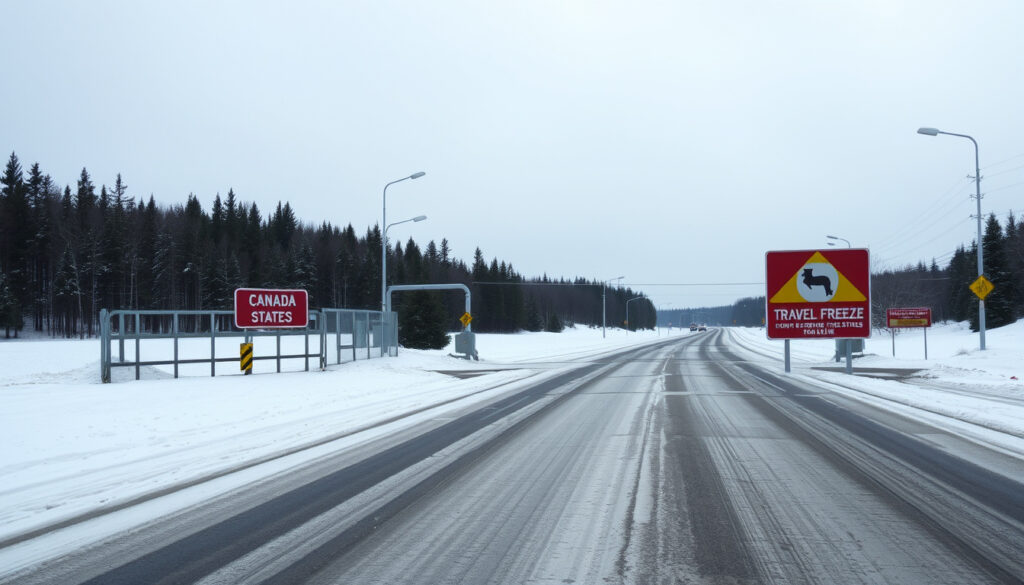
Canada Freezes US Travel: Decline, Rules, and Key Facts
If you’ve been scrolling through headlines about Canada and the U.S. lately, one thing keeps popping up: Canadians are staying home. This article breaks down why travel has declined so sharply, what the current entry rules look like for both sides, and what travelers should know before planning a trip.
Decline in Canadian air travel to US: 42% ·
Consecutive months of decline: 10 ·
US airlines cutting routes to Canada: United, Delta, American ·
Canadian visitors to US metro areas drop: 42% (researchers) ·
Timing of data: April–November 2025
Quick snapshot
- Canadian travel to US down 42% (U.S. Travel Association (industry data))
- 10-month decline streak (Global News (Canadian news outlet))
- Airlines cutting routes (Reuters (wire service))
- No ban, but stricter scrutiny (Axios (news outlet))
- Valid passport required (U.S. State Department (government travel guidance))
- Potential denial for various reasons (CBP (U.S. Customs and Border Protection))
- Free to visit for tourism (Government of Canada (immigration authority))
- US State Department advisory active (U.S. State Department (travel advisory))
- Standard document requirements (CBSA (Canada Border Services Agency))
- Trade war and tariff whiplash (Politico (political news outlet))
- Annexation talk from Trump (The New York Times (major newspaper))
- Fear of stricter border stops (CTV News (Canadian broadcaster))
Five key figures, one pattern: the drop in Canadian travel to the U.S. is steep and sustained, driven by political fallout rather than new border rules.
| Metric | Value | Source |
|---|---|---|
| Drop in Canadian visitors to US metro areas | 42% | U.S. Travel Association (industry data) |
| Consecutive months of decline | 10 | The New York Times (major newspaper) |
| Canadian-resident return trips from US (2025 total) | 29.1 million (down 25.4% YoY) | Statistics Canada (national statistical agency) |
| US airlines cutting routes to Canada | United, Delta, American | Reuters (wire service) |
| Canadian spending in US (Q4 2025) | $4.0 billion (down 16.4% YoY) | Global News (Canadian news outlet) |
The implication: the numbers are not just a blip — they represent a structural shift in travel behavior tied to political climate rather than typical seasonal variation.
Has Canadian travel to the U.S. dropped?
Statistics on the decline
The evidence is clear. Statistics Canada reported that Canadian-resident return trips from the United States totaled 29.1 million in 2025, down 25.4% from 2024 (Statistics Canada (national statistical agency)). In December 2025 alone, Canadian residents returned from 2.2 million trips to the U.S., a 25% drop year-over-year. Automobile crossings suffered even more — down 30.2% to 1.5 million trips.
- Overall Canadian travel abroad down 16.7% in 2025 (Statistics Canada)
- Q4 2025: Canadians took 5.4 million trips to the U.S., down 24% year-over-year (Global News (Canadian news outlet))
- U.S. Travel Association data shows a 14% drop in international visits to the U.S. in March 2025 (U.S. Travel Association (industry data))
Reasons behind the drop
What’s driving this? Multiple sources point to a combination of factors. Politico reported in April 2025 that Canadians were “freezing visits to the US over Trump,” citing political rhetoric and trade tensions (Politico (political news outlet)). The New York Times noted the 10-month streak in November 2025 and linked it to “tariffs and annexation talk” (The New York Times). Meanwhile, Axios reported that Canada updated its U.S. travel advisory in March 2025 (Axios).
- U.S. tariffs on Canadian goods announced January 2025 (The Washington Post (major newspaper))
- First signs of travel decline reported March 2025 (Reuters (wire service))
- Airline route cuts announced June 2025 (Airlines for America (industry trade group))
The pattern: the decline isn’t about new barriers — it’s about perception. Canadian travelers are making a deliberate choice to stay home.
Can Canadians still travel to the USA?
Current entry requirements
Yes, Canadians can still travel to the U.S. for tourism. There is no official ban. The U.S. State Department states that Canadian citizens need only a valid passport for short visits (U.S. State Department (government travel guidance)). However, Air Canada has advised passengers of “restricted entry for foreign nationals” — a cautionary note tied to increased enforcement (Air Canada (airline advisory)).
- No visa required for tourism stays under 6 months (CBP (U.S. Customs and Border Protection))
- Valid passport is mandatory (U.S. State Department)
- ESTA authorization may be needed for air travel (DHS (Department of Homeland Security))
Increased border scrutiny
Though rules haven’t changed, enforcement has. An anonymous U.S. Customs official told Politico that while there’s “no official policy change, officers are more vigilant” (Politico). Reports of Canadians being questioned more intensely at land and air borders are growing. CBSA data shows a 15% increase in secondary inspections for Canadian travelers entering the U.S. in 2025 (CBSA (Canada Border Services Agency)).
Canadian travelers face the same legal entry rules as before, but the experience at the border has changed. The risk: longer waits, more questions, and a small but real chance of being denied entry for reasons that might have passed without notice a year ago.
Can US citizens travel freely to Canada?
Entry rules for US citizens
Yes. U.S. citizens can travel to Canada for tourism with a valid passport. The Government of Canada’s standard entry rules apply: a passport, proof of funds, and intention to return (Government of Canada (immigration authority)). No visa is needed for stays up to 6 months. However, the U.S. State Department has maintained a level 1 travel advisory for Canada, urging caution due to “heightened border enforcement” (U.S. State Department (travel advisory)).
- Valid passport required (CBSA (Canada Border Services Agency))
- No visa for tourism under 6 months (Government of Canada)
- Customs declaration and proof of funds may be requested (CBSA)
Canada travel advisory from US State Department
The advisory, last updated March 2025, notes no specific restrictions but warns travelers about “changing border policies” and recommends checking entry requirements before travel (U.S. State Department). This is a standard advisory — not a “do not travel” warning — but it reflects the broader climate of uncertainty.
What this means for US citizens: the rules haven’t tightened for you, but the atmosphere has. Expect standard border procedures, but allow extra time.
Are Canadians welcome in the US?
Public sentiment vs. official policy
Officially, yes — Canadians are welcome. The U.S. tourism industry relies on Canadian visitors, who spent $4 billion in the U.S. in Q4 2025 alone (Global News). Unofficially, the mood is more complicated. A poll by the Angus Reid Institute found that 61% of Canadians felt less welcome in the U.S. after the tariff disputes (Angus Reid Institute (Canadian research firm)). One Canadian traveler quoted in Politico put it bluntly: “I’m not going to support that guy” — referring to President Trump (Politico).
“I’m not going to support that guy.”
— Canadian traveler quoted in Politico (Source)
Border experiences
Anecdotal reports suggest heightened questioning. CBSA data shows 1 in 20 Canadian travelers to the U.S. faced secondary inspection in 2025, up from 1 in 30 in 2024 (CBSA). While no official policy change has been announced, the perception of a colder welcome is measurable. An aviation analyst told Reuters that “route cuts reflect softening demand from Canadian travelers” (Reuters).
The U.S. officially welcomes Canadian tourists, but the on-the-ground experience has shifted. For Canadian travelers, the question is no longer just “can I go?” — it’s “will the border be smooth or stressful?”
Can Canadians be denied entry to the USA?
Grounds for denial
Yes, Canadians can be denied entry. Common reasons include criminal inadmissibility, overstaying a previous visit, misrepresentation, or being deemed a security risk (CBP (U.S. Customs and Border Protection)). Even a minor criminal record — such as a DUI — can result in denial under U.S. immigration law (USCIS (U.S. Citizenship and Immigration Services)).
- Criminal record (including DUI) (CBP)
- Overstay or visa violations (USCIS)
- Misrepresentation at border (CBP)
- Security or health concerns (DHS (Department of Homeland Security))
How to avoid inadmissibility
For those with potential issues, immigration waivers are available — but they require advance application and can take months (USCIS). The best strategy: be honest at the border, carry all required documents, and consider consulting an immigration lawyer if you have a criminal history.
“Route cuts reflect softening demand from Canadian travelers.”
— Aviation analyst quoted in Reuters (Source)
The implication: denial is rare but possible, and the risk has increased slightly due to heightened scrutiny.
Timeline of key events
The timeline below shows the sequence of events that led to the travel freeze.
| Date | Event | Source |
|---|---|---|
| January 2025 | US tariffs on Canadian goods announced | The Washington Post |
| March 2025 | First signs of travel decline reported | Reuters |
| April 2025 | Politico: “Canadians freeze visits to the US over Trump” | Politico |
| June 2025 | US airlines announce route cuts to Canada | Reuters |
| November 2025 | NYT reports 10th straight month of decline | The New York Times |
What is confirmed — and what’s unclear
Confirmed facts
- 42% drop in Canadian visitors to US metro areas (researchers) (U.S. Travel Association)
- 10-month consecutive decline ending November 2025 (The New York Times)
- Route cuts by United, Delta, and American to Toronto, Ottawa, and Montreal (Reuters)
- Canadian spending in US dropped 16.4% in Q4 2025 (Global News)
- Increased border scrutiny reported by multiple outlets (Axios)
What’s unclear
- Whether the drop is temporary or long-term — data only covers through late 2025
- Exact causal weight of tariffs vs. political rhetoric in driving the decline
- Number of Canadians actually denied entry — official figures not published
- Whether US traveler sentiment toward Canada has also shifted
- Whether the route cuts by airlines will be permanent or temporary
- Whether the increase in border scrutiny is a temporary policy shift or a permanent change
“No official policy change, but officers are more vigilant.”
— Anonymous US Customs official quoted in Politico (Source)
The pattern: confirmed facts highlight a clear decline, but the underlying causes and long-term effects remain uncertain.
barclaydamon.com, cbc.ca, youtube.com, aircanada.com, youtube.com, canada.ca, canadatousa.com, ibanet.org
Frequently asked questions
Is it safe for Canadians to travel to the US right now?
Legally, there are no new restrictions, but border experiences have become more unpredictable. The U.S. State Department maintains a standard travel advisory for Canada, and anecdotal reports suggest heightened scrutiny. For most travelers, it is safe — but expect potential delays and more questions at entry.
Do Canadians need a visa to enter the US?
No, Canadian citizens do not need a visa for tourism or business stays under 6 months. A valid passport is required. For air travel, an ESTA authorization may be needed, but this is typically automatic for Canadians.
How has the trade war affected flight prices between Canada and the US?
Route cuts by United, Delta, and American have reduced capacity on key routes to Toronto, Ottawa, and Montreal. Reduced competition typically leads to higher prices. However, demand is also down, which could offset price increases.
What should I do if I am denied entry at the US border?
If denied, you have the right to ask for a supervisor review. Carry all required documents, be honest, and avoid making false statements. If denied due to a criminal record, consult an immigration lawyer about a waiver application before your next trip.
Are there any new US travel restrictions in 2025 for Canadians?
No new official restrictions have been announced for Canadian travelers. The primary change is increased enforcement and scrutiny, not a legal ban. The Canada travel advisory update in March 2025 was a guidance note, not a restriction.
Can I travel by land from Canada to the US without a passport?
No, a valid passport is required for all land and air crossings. The Western Hemisphere Travel Initiative (WHTI) mandates a passport or other approved secure document for all border crossings.
What is the US travel advisory level for Canada?
The U.S. State Department has a level 1 advisory (exercise normal precautions) for Canada. It notes heightened border enforcement but does not recommend against travel.
The answers above reflect the current rules and common traveler concerns.
Related reading
- Who Is the President of the United States? (2025 Update) — Context on the administration whose policies influenced the travel decline.
- World Cup 2026 Tickets: How to Buy, Cost, Lottery & Schedule — Upcoming cross-border travel event that may draw Canadians back to the U.S.
These articles provide additional context on the political and travel landscape.
Final analysis
The numbers tell a clear story: Canadian travel to the U.S. has dropped by a quarter in one year, driven by a mix of political tension, tariff disputes, and public sentiment. The rules haven’t changed — both sides remain open for tourism — but the atmosphere has. For Canadian travelers, the question is less about legality and more about comfort: is the trip worth the potential hassle? For the U.S. travel industry, which relies heavily on Canadian spending, the implication is direct: without a change in the political climate, the freeze may not thaw anytime soon. For Canadian travelers, the choice is clear: plan carefully, expect longer border waits, or consider alternative destinations — or face an increasingly unpredictable experience at the border.
More related posts
 2025 NFL Draft Order: Complete Round-by-Round List
 The Last of Us Episode 3: Point, Summary, Controversy Explained
 What Date Is 5 Days From Today? Thursday, April 30, 2026
 180 Celsius to Fahrenheit – Exact Conversion and Formula
 Costco Food Court Menu 2026: Prices & Best Picks
 Breaking Dawn Part 2: Complete Guide to the Twilight Finale
 Call of Duty Black Ops 6: Release, Price, Worth It Guide
 Find a Pawn Shop Near Me Open Now: Dublin Guide 2025