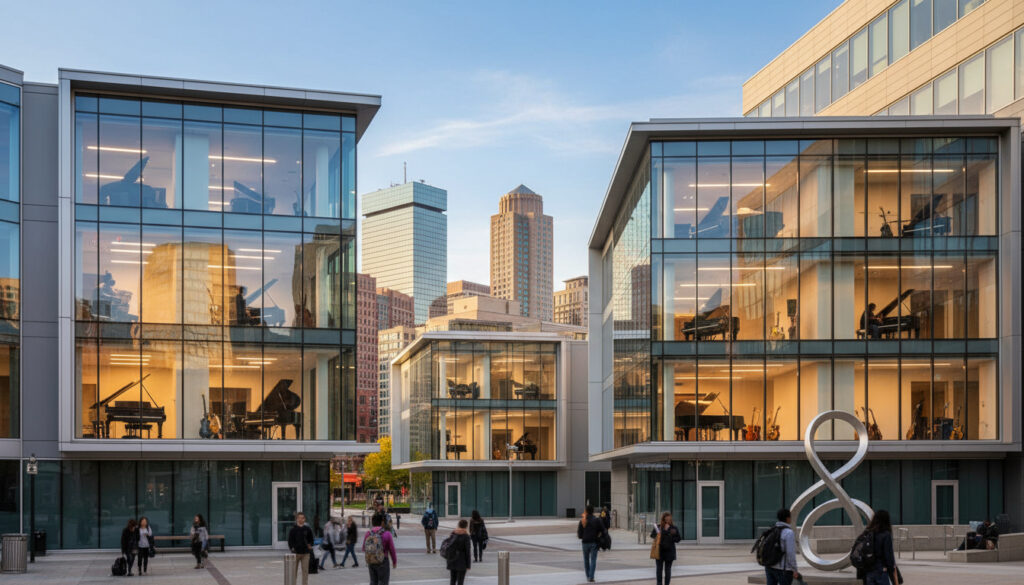
Berklee College of Music – Admissions, Tuition, Programs Guide
Berklee College of Music operates as the largest independent college of contemporary music in the world, distinguishing itself from traditional conservatories through an emphasis on modern genres and practical industry training. Founded in 1945 on the principle that students should learn contemporary music through study and practice rather than classical traditions, the institution has expanded from a small Boston school serving World War II veterans into a global network with campuses in Spain and New York City alongside a comprehensive online division.
Today, the college enrolls approximately 8,448 students across undergraduate and graduate programs, offering instruction in over 30 principal instruments and 15 distinct majors. Its reputation rests on direct connections to the music industry, with hundreds of alumni having earned recognition through Grammy, Tony, Oscar, and Emmy awards.
The college’s academic offerings, admissions selectivity, tuition costs, and historical development provide prospective students with fact-based insights into what Berklee offers and how it operates.
What is Berklee College of Music?
- Largest independent contemporary music college in the world
- Pioneer in online music education, having launched the first online undergraduate music degrees in 2002
- Industry-connected alumni network with hundreds of Grammy, Tony, Oscar, and Emmy winners
- Global campus network spanning three continents plus comprehensive distance learning
- Selective admissions with approximately 50% overall acceptance but significant variation by program
- Contemporary focus emphasizing jazz, rock, pop, and electronic music over classical traditions
| Fact | Details |
|---|---|
| Founded | 1945 |
| Founding Principle | Contemporary music through practice vs. classical traditions |
| Main Campus Address | 1140 Boylston Street, Boston, MA |
| Total Enrollment | ~8,448 students |
| Undergraduate Enrollment | ~7,608 students |
| Student-Faculty Ratio | 10:1 to 11:1 |
| Undergraduate Majors | 15 |
| Principal Instruments | 30+ |
| Accreditation | New England Commission of Higher Education (NECHE) |
| Acceptance Rate (overall) | ~49-50% |
| Annual Tuition | $50,270 |
Where is Berklee College of Music Located and What Campuses Does It Have?
The Boston Campus
The main campus occupies 1140 Boylston Street in Boston, Massachusetts, serving as the institution’s operational hub. This location houses state-of-the-art recording studios, modern performance spaces, and professional-grade technology supporting the college’s hands-on educational model. The Boston site remains the most selective of Berklee’s physical locations.
International Expansion
Beyond Boston, Berklee operates campuses in Valencia, Spain, and New York City. The Valencia campus offers graduate programs and specialized study abroad opportunities within Europe’s music market. The New York City location provides additional performance venues and networking access in the United States’ largest media center, complementing the main campus’s industry connections.
Berklee Online
The college’s online division extends its reach globally, having taught more than 30,000 students from 144 countries since inception. Berklee Online was the first institution to offer online undergraduate music degrees in 2002, and now delivers both undergraduate and graduate programs entirely through distance learning.
Acceptance rates differ significantly by location: the Boston campus admitted 33.8% of applicants in 2017-2018, while Berklee Online accepted 66% during the same period.
What Programs and Majors Does Berklee Offer?
Undergraduate Programs
Students select from 15 majors and over 30 principal instruments, culminating in a Bachelor of Music degree. Popular programs span Performance, Production, Songwriting, Music Therapy, Film Scoring, and Music Business. Additionally, Berklee offers a Bachelor of Arts in Music Industry Leadership and Innovation for students seeking broader industry management roles.
Graduate and Online Education
Master’s degrees launched in 2018, initially focusing on music production and music business. These programs operate at all three physical campuses and entirely online, allowing students to pursue advanced credentials without relocating to Boston. The online master’s programs mirror the curriculum of their on-campus equivalents.
Accreditation Status
The college holds accreditation from the New England Commission of Higher Education (NECHE), ensuring that degrees meet recognized academic standards and that students qualify for federal financial aid programs.
What is the Berklee College of Music Acceptance Rate and Admissions Process?
Selectivity Metrics
The overall acceptance rate hovers around 49-50%, though this figure masks significant variation by program. Between 2014 and 2017, the Boston campus accepted only 28-36% of applicants. The 2017-2018 data reveals a 33.8% rate for Boston, 38% for Boston Conservatory, and 66% for Berklee Online, indicating that campus choice substantially impacts admission probability.
Application Requirements
Berklee does not require or recommend SAT/ACT scores. Instead, the admissions committee weighs auditions, interviews, and academic records. Applicants must submit high school GPA and pay a $150 application fee. Priority deadlines fall on November 1, with final deadlines on January 15; early action is available for prepared candidates.
The evaluation process prioritizes musical auditions and personal interviews over standardized test scores, reflecting the college’s emphasis on practical talent and creative potential.
While the listed tuition is $50,270 annually, the net price after financial aid averages $48,608 per year, indicating that institutional aid covers only a modest portion of costs for the average recipient.
How Much Does Berklee College of Music Cost and What Financial Aid is Available?
Tuition and Expenses
Undergraduate tuition stands at $50,270 annually. After financial aid, the average net price drops to $48,608, suggesting that scholarships and grants reduce costs by less than $2,000 for the typical student. Additional expenses include housing, equipment, and materials specific to music production and performance studies.
Scholarship Opportunities
The college offers multiple affordability options including merit-based scholarships and various payment methods. Graduate students access separate financial aid resources through dedicated admissions channels. Prospective students should contact the financial aid office directly to determine specific eligibility requirements and award amounts, as these vary by program and individual circumstance. For additional resource management, see How Many Pounds in a Kilogram.
When Was Berklee College of Music Founded and How Did It Evolve?
- : Founded as Berklee School of Music with fewer than 50 students, many funded through the G.I. Bill — Wikipedia
- : Enrollment exceeds 500 students, ten times the initial class size — Wikipedia
- : Renamed Berklee College of Music after founder Lee Eliot Berk’s 12-year-old son to reflect expanded curriculum — Wikipedia
- : Berklee Online launches, becoming the first to offer online undergraduate music degrees — Wikipedia
- : Retention rates exceed 80% — Wikipedia
- : Master’s degree programs introduced in music production and music business — Wikipedia
What is Established About Berklee and What Remains Uncertain?
| Established Facts | Information Requiring Clarification |
|---|---|
| Founded in 1945 as Berklee School of Music | Current precise acceptance rates for specific campuses (latest detailed data from 2017-2018) |
| Largest independent contemporary music college globally | Up-to-date graduation and retention rates (latest cited are 2015-2016) |
| Accredited by NECHE | Exact current enrollment figures (sources cite approximate numbers) |
| Annual tuition of $50,270 | Specific scholarship award amounts and eligibility criteria |
| Student-faculty ratio of 10:1 to 11:1 | Placement rates and specific career outcome statistics post-graduation |
What Makes Berklee College of Music Significant in the Music Industry?
Berklee occupies a unique position as what the institution describes as “the preeminent institute of contemporary music and the performing arts.” Unlike traditional conservatories emphasizing classical repertoire, Berklee built its reputation on jazz, rock, pop, and electronic music, aligning its curriculum directly with commercial industry needs.
The college’s influence extends through its alumni network, which includes members of major acts like Nine Inch Nails, Dave Matthews Band, Sugarland, Train, and Karmin. Hundreds of alumni have earned Grammy, Tony, Oscar, and Emmy awards, reinforcing the school’s practical, industry-focused educational model and its role as a pipeline into professional music careers.
This network effect creates a self-reinforcing cycle: successful alumni return as guest lecturers, recruit current students for projects, and fund scholarships, while the college maintains state-of-the-art facilities that mirror professional recording and performance environments.
What Do Official Sources Say About Berklee’s Standing?
“The preeminent institute of contemporary music and the performing arts.”
“Students should learn contemporary music through study and practice rather than classical traditions.”
— Founding Principle, Berklee History
“Hundreds of Berklee alumni have been recognized with Grammy, Tony, Oscar, and Emmy awards.”
— Alumni Achievement Data
Is Berklee College of Music Worth Considering for Prospective Students?
Berklee offers a specialized education in contemporary music with a global footprint and demonstrable industry connections, but prospective students should weigh the approximately $50,000 annual tuition against the variable acceptance rates and limited average financial aid reduction. Those seeking to understand additional measurement comparisons can reference How Many Pounds in a Kilogram for technical conversion standards. The college suits students committed to modern genres and commercial music careers who can manage the substantial investment and competitive admissions process.
Frequently Asked Questions About Berklee
Is Berklee College of Music accredited?
Yes, Berklee holds accreditation from the New England Commission of Higher Education (NECHE).
Does Berklee College of Music offer online programs?
Yes, Berklee Online launched in 2002 as the first online undergraduate music degree program and now offers both bachelor’s and master’s degrees entirely online.
Are SAT or ACT scores required for admission?
No, SAT and ACT scores are neither required nor recommended for admission.
What is the student-to-faculty ratio?
The ratio ranges from 10:1 to 11:1, enabling personalized instruction.
How many Grammy winners have attended Berklee?
Hundreds of alumni have received Grammy awards, along with Tony, Oscar, and Emmy recognitions.
What is the application fee for Berklee?
The application fee is $150, with priority deadline November 1 and final deadline January 15.
More related posts
 Los Tigres del Norte: Members, Deaths, Songs & Net Worth
 metro pc pay bill
 Dan Da Dan Season 2 – Release Date, Trailers and Platforms
 A Court of Thorns and Roses Characters: Main Cast & Love Interest
 2025 F1 Driver Lineup: Complete List of Drivers and Teams
 Chad Powers Season 2: Release Date, Renewal & Episode 7 News
 Flight 6469 Emergency Landing: Comms Glitch Forces Return
 Leave the World Behind (Film) – Plot, Cast & Ending Explained