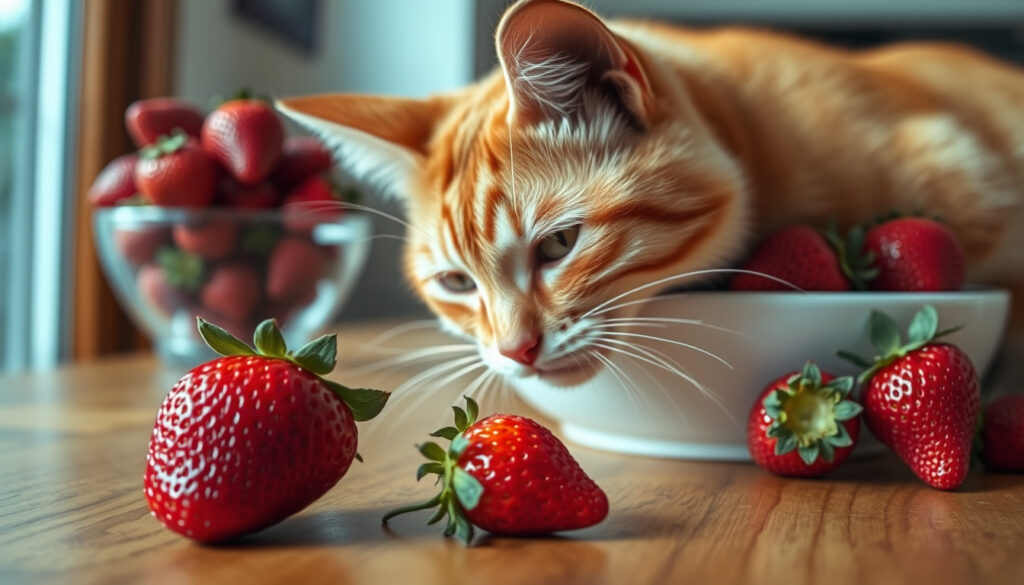
Can Cats Eat Strawberries? Safety, Risks & Safe Fruits
Few questions spark as much curiosity among cat owners as whether their feline friend can safely nibble on a strawberry. The short answer is yes — strawberries are not toxic to cats — but the real story involves sugar limits, proper preparation, and knowing which fruits to avoid entirely. Veterinary sources agree that a small piece can be a fine occasional treat, as long as you understand the risks that come with natural sugar content. By the end of this guide, you’ll know exactly how much is safe, how to serve it, and when to skip the fruit bowl entirely.
Safe for cats: Non-toxic in small amounts ·
Recommended serving: One small strawberry, cut into pieces ·
Risks: Obesity, diabetes, tooth decay from sugar ·
Alternative safe fruits: Blueberries, melon, cucumber
Quick snapshot
- Non-toxic (PetMD veterinary guide)
- Small serving only (PetMD veterinary guide)
- Wash and cut before serving (PetMD veterinary guide)
- High sugar leads to obesity (Hill’s Pet Nutrition)
- Diabetes risk (Hill’s Pet Nutrition)
- Tooth decay (Hill’s Pet Nutrition)
- Blueberries (Great Pet Care)
- Melon (Great Pet Care)
- Cucumber (Great Pet Care)
- Cranberries (Great Pet Care)
The pattern across all veterinary sources is consistent: strawberries are safe in tiny portions, but they offer no nutritional value for a cat’s obligate-carnivore diet.
| Fact | Value |
|---|---|
| Strawberries toxic? | No, non-toxic (PetMD) |
| Calories per medium strawberry | 4–5 kcal |
| Sugar per strawberry | 1 g |
| Max serving size | 1 small strawberry (Hill’s Pet Nutrition) |
| Suitable for kittens? | Yes, but smaller piece |
| Leaves safe? | Remove stems and leaves (PetFinder) |
Are strawberries toxic to cats?
Strawberries are not toxic to cats, according to PetMD’s veterinary team, and can be offered in moderation as an occasional treat. Hill’s Pet Nutrition confirms that while the fruit is not considered toxic to felines, it is not a healthy regular food for cats. The catch is entirely about sugar: one medium strawberry contains roughly 1 gram of sugar, and for a cat whose natural diet is virtually sugar-free, that adds up fast.
A cat that eats a whole strawberry gets the sugar equivalent of a human eating an entire slice of cake — fine once in a while, but problematic as a habit.
What happens if a cat eats a strawberry?
- Most cats experience no negative effects from a single small piece (Chewy, citing veterinarians)
- Too much can cause digestive upset, including vomiting or diarrhea
- Regular consumption of sugary treats raises the risk of obesity and diabetes
The implication: one strawberry piece is harmless; a daily habit is not. Owners should treat strawberries as an occasional novelty, not a dietary staple.
Can kittens eat strawberries?
- Kittens can eat a tiny piece of strawberry, but their digestive systems are more sensitive
- A piece no larger than a pea is appropriate for a kitten under 6 months
- Kittens need a balanced diet of kitten-specific food — treats should not replace meals
What this means: a kitten’s nutritional needs are far more demanding than an adult cat’s. Strawberries offer no developmental benefit, so keep the portion minuscule and the frequency low.
Why do cats go crazy for strawberries?
Some cats show an unusual interest in strawberries, and Great Pet Care notes that the attraction may come down to smell or texture rather than taste. Cats lack sweet taste receptors — they literally cannot taste sugar — so the appeal is likely tactile or olfactory. The fruit’s soft texture and bright scent may mimic the movement or smell of prey, triggering a cat’s curiosity.
Why do cats love strawberries?
- Cats are obligate carnivores and do not crave fruit biologically
- Strawberries’ scent may resemble certain plant compounds that attract cats
- Some cats simply enjoy batting at or pouncing on the fruit as a toy
The pattern: there is no confirmed scientific reason why some cats fixate on strawberries. It remains one of those charming feline mysteries.
Do cats taste sweet?
- Cats lack the T1R2 protein needed to detect sweetness (PetCircle)
- Their interest in strawberries is not driven by sugar appeal
- Texture, smell, or movement are more likely explanations
The catch: even though your cat acts thrilled about a strawberry, she is not tasting what you taste. The excitement is about something else entirely.
What fruit is cat safe?
Several fruits are safe for cats in small portions, but the list is narrower than most owners assume. Great Pet Care advises that treats — including fruit — should not exceed roughly 1 tablespoon per day. Here is how common fruits stack up.
Can cats eat blueberries?
- Blueberries are safe for cats in small amounts (PetMD)
- They are lower in sugar than strawberries, making them a slightly better option
- Wash thoroughly and cut in half to prevent choking
Why this matters: blueberries offer a lower-sugar alternative to strawberries for owners who want to give fruit treats.
Can cats eat strawberries raw?
- Yes, raw strawberries are fine — fresh or frozen — as long as they are plain (PetMD)
- Avoid dried, candied, canned, or chocolate-covered strawberries
- Frozen strawberries can be offered as a cold treat in hot weather
The trade-off: raw is the only safe form. Added sugar or coatings turn a harmless treat into a health risk.
Can cats eat strawberry leaves?
- Strawberry leaves are not toxic, but they are tough and hard to digest (PetMD)
- Remove stems and leaves to avoid gastrointestinal blockage
- BetterPet warns that leaves can cause choking or intestinal upset
What to watch: always trim the green parts before serving. The risk is mechanical, not chemical.
Can cats eat strawberry seeds?
- Strawberry seeds are tiny and soft — they pose no choking or toxicity risk
- Cutting the fruit into small pieces is still recommended to prevent any issue
- The seeds on the outside of a strawberry are harmless to cats
The verdict: seeds are not a concern. The bigger risk is the fruit’s sugar content and the potential for overeating.
What are 5 human foods toxic to cats?
While strawberries are safe, many common human foods are dangerously toxic to cats. PetFinder and Hill’s Pet Nutrition both emphasize that knowing which foods to avoid is just as important as knowing which are safe.
8 common human foods that are poisonous to cats
- Onions and garlic — damage red blood cells and cause anemia, even in small amounts
- Grapes and raisins — can cause acute kidney failure; the exact toxic dose is unknown
- Chocolate — contains theobromine and caffeine, which are toxic to cats
- Alcohol — even small amounts can cause severe liver and brain damage
- Caffeine — found in coffee, tea, and energy drinks; causes rapid heart rate and seizures
- Raw dough — can expand in the stomach and produce ethanol during fermentation
- Xylitol — artificial sweetener found in sugar-free gum and baked goods; causes rapid insulin release
- Dairy products — many adult cats are lactose intolerant and will experience digestive upset
The pattern: the most dangerous foods are those that affect the kidneys, red blood cells, or nervous system. Strawberries are safe, but grapes, raisins, onions, and garlic are not — and the difference can be life-threatening.
What is the silent killer of cats?
The phrase “silent killer” in feline health typically refers to chronic kidney disease or heart disease, both of which progress without obvious symptoms until they are advanced. PetCircle notes that obesity is a related silent health issue that significantly increases the risk of diabetes, arthritis, and urinary tract problems. Strawberries are not a direct cause of these conditions, but the high sugar content in treats can contribute to weight gain over time.
- Chronic kidney disease affects up to 30% of cats over 10 years old
- Obesity rates in domestic cats are estimated at 25–40% in developed countries
- Dietary sugar from treats, including fruit, plays a contributing role in weight gain
Why this matters: the occasional strawberry is not the problem. The cumulative effect of sugary treats, combined with a sedentary indoor lifestyle, is what puts cats at risk for the real silent killers.
A strawberry now and then is fine. The silent killer is not the fruit — it is the pattern of daily treats that add sugar to a cat’s diet without the cat needing or benefiting from it.
How to safely feed strawberries to your cat
Feeding strawberries safely requires a few simple steps that minimize risk and maximize safety. Hill’s Pet Nutrition recommends a portion the size of a small thumbnail, about 1/2 teaspoon, no more than once or twice per week. Here is a step-by-step guide.
- Wash the strawberry thoroughly to remove pesticides, dirt, or bugs (PetCircle)
- Remove the stem and leaves — these are tough and can cause digestive issues
- Cut into small pieces — a thumbnail-sized slice or smaller, depending on your cat’s size
- Offer a single piece — watch for any adverse reaction over the next 24 hours
- Limit frequency — no more than 1–2 times per week, and never replace a meal
Can cats eat strawberries with sugar?
- Never add sugar, honey, or any sweetener to strawberries for cats (PetMD)
- Added sugar increases the risk of obesity, diabetes, and tooth decay
- Plain, raw strawberries only — no toppings, syrups, or coatings
The rule: if you would not eat it plain, do not give it to your cat.
Can cats eat strawberry yogurt?
- Strawberry yogurt often contains added sugar and artificial flavors
- Many adult cats are lactose intolerant and cannot digest dairy properly
- A small lick of plain yogurt is safer, but strawberry-flavored yogurt is not recommended
Upsides
- Non-toxic and safe in small amounts (PetMD)
- Provides vitamin C and antioxidants (though cats produce their own vitamin C)
- Can be a fun, low-calorie treat for cats that enjoy the texture
- Frozen strawberries make a cooling snack in warm weather
Downsides
- High sugar content for an obligate carnivore (Hill’s Pet Nutrition)
- Regular feeding contributes to obesity and diabetes risk
- Leaves and stems pose a choking or blockage hazard
- Not a nutritionally necessary food for cats
What we know vs. what remains unclear
Confirmed facts
- Strawberries are non-toxic to cats (PetMD)
- High sugar content poses health risks with regular feeding (Hill’s Pet Nutrition)
- Leaves and stems should be removed before serving (PetFinder)
- Safe only in small amounts — one thumbnail-sized piece per serving (Hill’s Pet Nutrition)
What’s unclear
- Why some cats show strong interest in strawberries — taste is not the reason, but the exact trigger is unknown
- Long-term effects of occasional strawberry treats on cat health — no longitudinal studies exist
- Whether strawberry seeds pose any meaningful risk at all (current evidence says no, but data is limited)
“Many adult cats can safely enjoy a small amount of strawberries as an occasional treat, but they should not be a regular part of the diet.”
— Hill’s Pet Nutrition
“The short answer is yes, cats can eat strawberries in small amounts. However, the fruit should be treated as an additional treat rather than part of a routine diet.”
— PetMD veterinary team
“Strawberries are not considered toxic to cats, but they are not considered a healthy regular food for cats. A small thumbnail-sized slice once or twice a week is a safe amount.”
— Hill’s Pet Nutrition
“Cats with diabetes or a strawberry intolerance should not eat strawberries. For healthy cats, half a ripe strawberry per day is a reasonable maximum.”
The pattern across all veterinary sources is consistent: strawberries are safe in tiny portions, but they offer no nutritional value that a cat cannot get from its regular diet. The decision to feed strawberries is a treat-for-entertainment choice, not a health one. For cat owners who want to offer a safe fruit reward, the portion limits are clear — and the list of truly toxic foods is a more urgent thing to memorize.
For the average cat owner, the choice is straightforward: a thumbnail-sized piece of plain strawberry, washed and trimmed, once or twice a week is fine. Anything more frequent or larger shifts the risk-to-reward balance toward the negative. Stick with the small portion, or skip the fruit entirely and opt for a vet-approved cat treat instead.
pumpkin.care, yahoo.com, glenwoodpethospital.com, forpetshealthcare.com
Frequently asked questions
Can cats eat strawberries every day?
No. Hill’s Pet Nutrition recommends no more than once or twice per week due to the sugar content. Daily feeding increases the risk of obesity, diabetes, and tooth decay.
Do strawberries provide any nutritional benefit for cats?
Strawberries contain vitamin C and antioxidants, but cats produce their own vitamin C and do not require dietary sources. The nutritional benefit is negligible for an obligate carnivore, according to PetMD.
Can cats eat frozen strawberries?
Yes, plain frozen strawberries are safe and can be a refreshing treat in warm weather. PetMD confirms that fresh or frozen strawberries are acceptable, as long as they are free of added sugar or syrup.
What should I do if my cat eats a strawberry with a leaf?
Monitor your cat for signs of digestive upset, such as vomiting, diarrhea, or loss of appetite. BetterPet notes that the leaves are not toxic but can cause gastrointestinal blockage. Contact your veterinarian if symptoms persist or worsen.
Are strawberry seeds safe for cats?
Yes, the tiny seeds on the outside of a strawberry are harmless to cats. PetFinder advises that cutting the fruit into small pieces is still recommended for safety, but the seeds themselves pose no risk.
Can cats eat strawberry yogurt?
Strawberry yogurt is not recommended for cats. It typically contains added sugar and artificial flavors, and many adult cats are lactose intolerant. Chewy advises sticking to plain fruit or cat-specific treats instead.
What fruits are toxic to cats?
Grapes and raisins are the most dangerous common fruits — they can cause acute kidney failure. PetFinder also lists citrus fruits (oranges, lemons, limes) as potentially irritating, and cherry pits contain cyanide. Always remove pits and seeds from any fruit before offering it to your cat.
Can cats eat strawberries with whipped cream?
No. Whipped cream is high in sugar and dairy, both of which can cause digestive upset in cats. Great Pet Care recommends serving strawberries plain, with no toppings or additives.
Related reading: FDA Blueberry Recall 2026: Listeria Risk and Consumer Guide · Good Sources of Fiber: Top Foods & Daily Needs
More related posts
 Amex Gold Card Benefits 2026: Lounge & Rewards Guide
 Call of Duty Black Ops 6: Release, Price, Worth It Guide
 2025 NFL Draft Order: Complete Round-by-Round List
 Kendrick Lamar Net Worth 2026: $200M and Surpassing Drake
 La Liga Standings 2025-26: Current Table, Titles & Records
 Jackie Love Is Blind: Where Is Jackie Bonds Now? Split with Josh
 LSU vs South Carolina: Scores, History & Predictions
 Why Am I Bleeding on the Pill When I Shouldn’t Be? Causes & Fixes