When to Worry About Blood in Stool: A Quick Guide
Few things catch your attention quite like seeing blood in the toilet bowl. It’s unsettling, and your first thought might be the worst-case scenario. But the truth is, most cases of rectal bleeding are caused by benign conditions like hemorrhoids or anal fissures. Still, understanding when to take it seriously could make all the difference, and that’s exactly what this guide helps you do.
Adults reporting rectal bleeding yearly: up to 1 in 10 · Most common cause: anal fissures or hemorrhoids · Colorectal cancer linked to visible blood: less than 5% of cases · Bright red blood indicates lower GI origin: over 90% of presentations
Quick snapshot
- Bright red blood that drips or streaks is most often from hemorrhoids or fissures (Cleveland Clinic (gastroenterology))
- Any rectal bleeding persisting beyond 3 weeks warrants medical evaluation (NHS (UK health authority))
- Large volume bleeding (>1 tablespoon) is a medical emergency (Harvard Health Publishing (consumer health))
- The exact volume of blood that is ‘concerning’ for cancer is not defined in any guideline (Cleveland Clinic (gastroenterology))
- Whether self-limiting bleeding from hemorrhoids requires a colonoscopy in low-risk patients is debated (Harvard Health Publishing (consumer health))
- Seek medical care if bleeding persists for 3 consecutive weeks (NHS (UK health authority))
- Immediate emergency care required if bleeding is heavy, non-stop, or accompanied by dizziness (Cleveland Clinic (gastroenterology))
- For bright red streaks likely from hemorrhoids: increase fiber, use warm baths, and monitor for 1–2 weeks (Cleveland Clinic (gastroenterology))
- If bleeding stops and no other symptoms, still schedule a routine check-up (NHS (UK health authority))
The pattern in the table below shows how prevalence and risk shift with age and cause.
| Key fact | Detail |
|---|---|
| Annual incidence of rectal bleeding in adults | 10–15% according to population studies |
| Proportion with underlying colorectal cancer | 2–5% of patients with visible blood |
| Time to seek care for persistent bleeding | 3 weeks (NHS guideline) |
| Common benign causes | hemorrhoids, anal fissures, diverticulosis, polyps |
The implication: most cases are benign, but the 2–5% cancer link means no episode should be dismissed without evaluation.
How much blood in stool is concerning?
Small streaks vs. large volume
- A few streaks on toilet paper or a drop in the bowl – often from a fissure or hemorrhoid – is low concern if it’s a single episode (Cleveland Clinic (gastroenterology)).
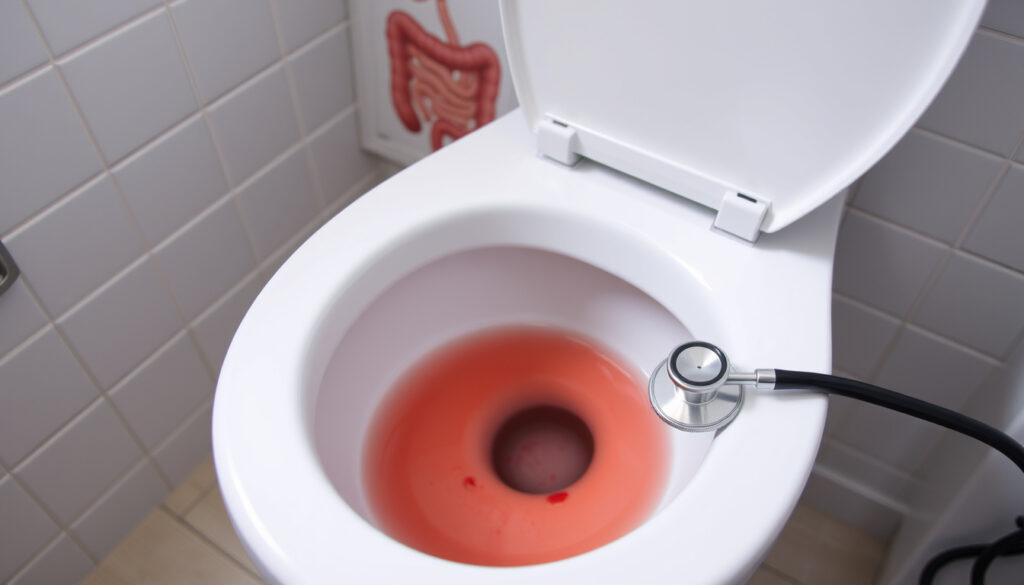
- When the toilet water turns red or you see blood clots, that’s a large volume and requires immediate medical attention (Harvard Health Publishing (consumer health)).
- The NHS advises seeking emergency care if you’re “bleeding non-stop” or “there’s a lot of blood” (NHS (UK health authority)).
Repeated bleeding vs. single episode
- A single episode after a bout of constipation is likely a fissure and can be managed at home (healthdirect Australia (government health service)).
- Bleeding that happens more than once, especially if it’s painless, warrants a doctor’s exam (Mayo Clinic (medical research center)).
- Persistent bleeding for 3 weeks or more should always be investigated, even if small (NHS (UK health authority)).
A single episode of bright red blood after straining is rarely dangerous, but the same appearance from a painless bleed could be a polyp or early cancer. The volume and repetition are the real triage tools.
Can blood in stool heal itself?
When self-limited causes heal (fissures, hemorrhoids)
- Anal fissures often heal within a few weeks with stool softeners and sitz baths (NHS (UK health authority)).
- Hemorrhoids may resolve with increased dietary fiber and topical creams (Cleveland Clinic (gastroenterology)).
- Drinking plenty of water, eating a varied diet, staying active, and avoiding straining can prevent recurrence (healthdirect Australia (government health service)).
When medical treatment is necessary
- Inflammatory bowel disease (Crohn’s, ulcerative colitis) and diverticulosis require medical management – they won’t heal on their own (healthdirect Australia (government health service)).
- Bleeding from polyps or tumors also needs intervention, often via colonoscopy (Harvard Health Publishing (consumer health)).
- If you are on anticoagulants (warfarin, apixaban) and see blood, consult your doctor immediately – the medication may need adjustment (NHS (UK health authority)).
Self-healing is possible only when the cause is a simple mechanical tear or hemorrhoid. Without a confirmed diagnosis, bleeding that stops temporarily can fool you into missing a more serious source.
When to worry about blood in stool?
Red flags for urgent care
- Bleeding that is heavy, non-stop, or accompanied by lightheadedness, fainting, or severe abdominal pain – these are emergency signs (Cleveland Clinic (gastroenterology)).
- Dark maroon or black stool may indicate upper GI bleeding (stomach or small intestine) and requires immediate evaluation (NHS (UK health authority)).
- Unexplained weight loss, anaemia, or a change in stool caliber together with blood are red flags for colorectal cancer (Harvard Health Publishing (consumer health)).
Chest pain or dizziness together with rectal bleeding
- Chest pain plus rectal bleeding could signal a cardiovascular event or significant blood loss – call 911 (Ubie Health (symptom triage)).
- Dizziness or fainting suggests a drop in blood pressure from major blood loss; this is a medical emergency (Harvard Health Publishing (consumer health)).
What color is cancerous blood in stool?
Bright red vs. dark red vs. black
- Bright red blood (hematochezia) usually comes from the lower colon, rectum, or anus – it can be from cancer, but also from benign causes (Cleveland Clinic (gastroenterology)).
- Dark red or maroon blood suggests a source in the ascending or transverse colon (NHS (UK health authority)).
- Black, tarry stool (melena) indicates bleeding from the stomach or small intestine – often from ulcers, but can be cancer (Harvard Health Publishing (consumer health)).
Mixed vs. coating stool surface
- Blood mixed into the stool (not just on the surface) is more concerning for a proximal source, such as a polyp or tumor (The Independent (UK news)).
- Blood that coats the outside or appears on wiping is typical of hemorrhoids or fissures (Mayo Clinic (medical research center)).
Color alone doesn’t rule out cancer – bright red can still be malignant. But the combination of dark color, large volume, and blood mixed in raises the suspicion significantly.
What is the most common reason for bloody stools?
Hemorrhoids and anal fissures
- Hemorrhoids are the most common cause of bright red blood on toilet paper or in the bowl (Cleveland Clinic (gastroenterology)).
- Anal fissures are common after passing hard stool, often causing a sharp pain followed by a few drops of blood (NHS (UK health authority)).
- Both conditions are benign and highly treatable with dietary changes and topical care (Harvard Health Publishing (consumer health)).
Diverticulosis and polyps
- Diverticulosis (pouches in the colon wall) can cause painless, often large-volume bleeding, especially in people over 50 (healthdirect Australia (government health service)).
- Colonic polyps can bleed without any pain; they are removed during colonoscopy because some can become cancerous (Harvard Health Publishing (consumer health)).
What can be mistaken for blood in stool?
Foods that mimic blood
- Beets, red gelatin, cranberries, and tomato juice can color stool red and be mistaken for blood (Harvard Health Publishing (consumer health)).
- A fecal occult blood test can distinguish true blood from food pigments (Harvard Health Publishing (consumer health)).
Medications that darken stool
- Iron supplements and bismuth subsalicylate (Pepto-Bismol) can cause black stool that resembles melena (NHS (UK health authority)).
- Dark berries and licorice can also cause dark stools (Harvard Health Publishing (consumer health)).
Always recall what you ate or took recently. If the color change matches a known food or medication, a stool test can confirm whether it’s blood.
What is the 3 to 3 poop rule?
Definition and origin
- The 3 to 3 poop rule suggests seeing a doctor if you have 3 or more bowel movements with blood within 3 days, or if blood is present for 3 consecutive weeks (NHS (UK health authority)).
- Not a formal medical guideline but a public health heuristic to prompt earlier consultation (Cleveland Clinic (gastroenterology)).
When to apply this rule
- Use it if you have no other red flags but notice recurring blood over days or weeks (Harvard Health Publishing (consumer health)).
- If you meet the 3-by-3 threshold, schedule a doctor’s appointment rather than continuing to wait (NHS (UK health authority)).
What to do if you notice blood in stool
- Check the color and amount. Bright red streaks on paper are less urgent than dark red or black stool. If the toilet water turns red, consider it heavy bleeding (Cleveland Clinic (gastroenterology)).
- Assess associated symptoms. Pain, dizziness, fever, or weight loss raise the urgency. Painless bleeding alone is still worth a check-up (Ubie Health (symptom triage)).
- Try home care if it’s likely a fissure or hemorrhoid. Increase fiber (see Good Sources of Fiber), take warm baths, and use topical hemorrhoid cream. Avoid straining (healthdirect Australia (government health service)).
- Monitor for 48 hours. If bleeding stops and you feel fine, schedule a routine appointment. If it continues or recurs, see a doctor sooner (NHS (UK health authority)).
- When in doubt, call your GP. They can arrange a stool test or referral for a colonoscopy if needed. Don’t let embarrassment delay care – rectal bleeding is very common (Harvard Health Publishing (consumer health)).
If you are over 50 or have a family history of colorectal cancer, even a single episode of painless blood should prompt a colonoscopy, not just home monitoring.
Confirmed facts
- Bright red blood that drips or streaks is most often from hemorrhoids or fissures (Cleveland Clinic (gastroenterology))
- Any rectal bleeding persisting beyond 3 weeks warrants medical evaluation (NHS (UK health authority))
- Large volume bleeding (>1 tablespoon) is a medical emergency (Harvard Health Publishing (consumer health))
- Black stool or maroon stool indicates upper GI bleeding until proven otherwise (NHS (UK health authority))
What’s unclear
- The exact volume of blood that is ‘concerning’ for cancer is not defined in any guideline (Cleveland Clinic (gastroenterology))
- Whether self-limiting bleeding from hemorrhoids requires a colonoscopy in low-risk patients is debated (Harvard Health Publishing (consumer health))
- The role of diet vs. medications in causing false-positive stool color changes (Harvard Health Publishing (consumer health))
Expert perspectives on rectal bleeding
“You should see a GP if you have bleeding from your bottom for any reason. They can check for things like haemorrhoids and also look for more serious causes.”
– NHS, NHS (UK health authority)
“Seek immediate medical care if the bleeding is heavy or doesn’t stop, or if you also have chest pain, difficulty breathing, or dizziness.”
– Cleveland Clinic, Cleveland Clinic (gastroenterology)
“Bright red blood on the toilet paper or on the surface of the stool is often from hemorrhoids or an anal fissure. But if the blood is mixed into the stool, it’s more concerning.”
– Harvard Health Publishing, Harvard Health Publishing (consumer health)
Seeing blood in your stool is never normal, but it’s rarely a crisis. The key is to use the color, volume, and pattern of bleeding as a triage tool. For the vast majority of people, especially those under 50, the cause is a benign fissure or hemorrhoid that will settle with simple home care. But if bleeding persists, recurs, or comes with other symptoms, a timely check-up could catch a polyp or early cancer when it’s most treatable. For patients over 50 or with a family history of colorectal cancer, the choice is clear: schedule a colonoscopy, or risk a late diagnosis.
Related reading: Good Sources of Fiber · How to Get Rid of Acid Reflux Fast
goodrx.com, verywellhealth.com, webmd.com, assets.publishing.service.gov.uk, livedsupport.com
Frequently asked questions
Can a small amount of blood in stool go away on its own?
Yes, if it’s from a minor fissure or hemorrhoid, it often resolves within a few days with dietary changes. But if it returns or persists, see a doctor.
Does bright red blood always mean hemorrhoids?
No. While hemorrhoids are the most common cause, bright red blood can also come from fissures, polyps, diverticulosis, or even cancer. A proper exam is needed to confirm.
What does it mean if I see blood after a bowel movement but no pain?
Painless bleeding is more common with hemorrhoids, but it can also be a sign of polyps or diverticulosis. Painless bleeding should still be evaluated.
Is blood in stool common during pregnancy?
Yes, due to increased pressure on rectal veins. Hemorrhoids are very common in pregnancy, but any new bleeding should be discussed with a midwife or GP.
Should I go to the ER for blood in stool or wait for my doctor?
Go to the ER if you have heavy bleeding, blood clots, dizziness, fainting, or severe pain. For small streaks, a same-week GP appointment is appropriate.
How do doctors determine the cause of rectal bleeding?
Doctors start with a medical history, digital rectal exam, and stool test. If needed, they may order a colonoscopy or sigmoidoscopy to see the source.
What home remedies help stop rectal bleeding?
Increase fiber intake, drink plenty of water, take warm sitz baths, and use over-the-counter hemorrhoid creams. Avoid straining and prolonged sitting on the toilet.
Is blood in stool always a sign of something serious?
No. Most cases are from benign causes. However, any bleeding deserves attention because the only way to know it’s benign is to rule out serious causes.
More related posts
 Georgie & Mandy’s First Marriage Cast – Main Actors & Characters
 Denver Broncos vs 49ers Match Player Stats: Aug 9, 2025
 Respondus LockDown Browser Download Guide
 Where’s My Tax Refund? Check Your IRS Status
 Tigres UANL vs Toluca: Record, History & Latest Match
 Jennifer Love Hewitt 2025 – Confirmed Projects and Roles
 What Is the 13th Amendment? Simple Explanation and Impact
 Did Sanders Get Drafted? Shedeur’s 2025 NFL Slide Explained