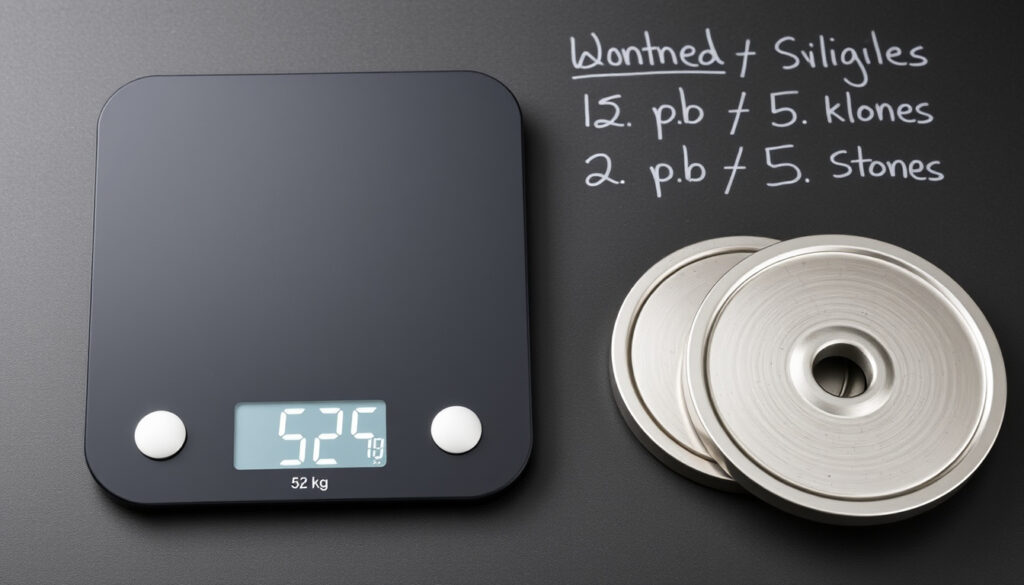
52 kg to lbs – Convert 52 Kilograms to Pounds and Stones
Staring at a luggage scale or a fitness tracker, you’ve probably faced the moment when kilograms need to become pounds — fast. For 52 kg, the exact conversion is 114.6404 pounds, but that number only tells part of the story if you’re dealing with stone measurements or just a quick mental check. This guide unpacks the precise math, shows you how to do it yourself, and explains why knowing both pounds and stone matters for travel, health, and everyday life.
1 kilogram: 2.20462 pounds ·
52 kilograms: 114.6404 pounds ·
52 kilograms: 8 stone 2.6 pounds ·
1 stone: 14 pounds ·
1 kilogram: 0.157473 stone
Quick snapshot
- 52 kg = 114.6404 lbs (Inch Calculator (conversion tool))
- 52 kg = 8 stone 2.6 lbs (The Calculator Site (weight chart publisher))
- 1 kg = 2.20462 lbs (Metric Conversions (conversion reference))
- Exact pounds can vary by rounding — some sources show 114.64, others 114.6404 (Symbolab (math tool provider))
- Stone conversion can be listed as 8.19 stone or 8 st 2.6 lb depending on precision (The Calculator Site (weight chart publisher))
- The conversion factor (1 kg = 2.20462262185 lb) is defined by international agreement and has not changed since the 1959 International Yard and Pound Agreement (RapidTables (conversion reference))
- Learn the manual multiplication steps to convert any kg value to pounds and stones (Inch Calculator (conversion guide))
Four key facts from the research, one pattern: the same conversion factor scales linearly, but rounding choices produce slightly different outputs for stones and pounds.
| Label | Value | Source |
|---|---|---|
| 52 kg in pounds (exact) | 114.640376336 lbs | kg-to-lbs.appspot.com (conversion tool) |
| 52 kg in pounds (4 decimals) | 114.6404 lbs | Inch Calculator (conversion tool) |
| 52 kg in pounds (2 decimals) | 114.64 lbs | The Calculator Site (weight chart publisher) |
| 52 kg in stones (decimal) | 8.19 stone | The Calculator Site (weight chart publisher) |
| 52 kg in stone + pounds | 8 stone 2.6 lb | The Calculator Site (weight chart publisher) |
| Conversion factor (kg to lb) | 2.20462262185 | RapidTables (conversion reference) |
| Conversion factor (lb to kg) | 0.45359237 | RapidTables (conversion reference) |
| 1 stone | 14 pounds | The Calculator Site (weight chart publisher) |
What is 52 kg in stones and lbs?
52 kilograms converts to 8 stone 2.6 pounds when expressed in the traditional UK stone-and-pound format. The exact pounds portion is 114.6404, which after dividing by 14 (pounds per stone) leaves 2.6 pounds as the remainder. The Calculator Site (weight chart publisher) lists this value in its conversion chart, and the NHS Grampian (health authority) PDF confirms the same range for medical weight tracking.
The pattern: the stone-plus-pounds format is the one you will actually see on a UK bathroom scale.
How to convert 52 kg to stones and pounds manually
- Multiply 52 by 2.20462262185 to get pounds: 52 × 2.20462262185 = 114.640376336 lb. (RapidTables (conversion reference))
- Divide the total pounds by 14 to find stones: 114.6404 ÷ 14 ≈ 8.1886 stone. The integer part is 8 stone.
- Multiply the decimal remainder (0.1886) by 14 to get leftover pounds: 0.1886 × 14 ≈ 2.6404 lb. Rounded to one decimal: 2.6 lb. (Inch Calculator (conversion tool))
What is the exact conversion for 52 kg?
The exact conversion using the international standard factor 2.20462262185 gives 114.640376336 pounds. Most consumer sources round to 114.64 lb or 114.6404 lb. kg-to-lbs.appspot.com (conversion tool) outputs 114.640376336, while CoolConversion (conversion site) gives the same figure to six decimal places. For stone, the precise value is 8.1886 stone, commonly written as 8 st 2.6 lb.
How much is 1 kg to 1 pound?
The conversion factor between kilograms and pounds is fixed by international standards. One kilogram equals exactly 2.20462262185 pounds. Inch Calculator (conversion reference) uses 2.204623 for most calculations, while Metric Conversions (conversion authority) states 2.20462. The slight differences come from rounding, not from disagreement about the true value.
What is the exact conversion rate?
The exact rate is 2.20462262185 lb per kg. In reverse, 1 lb equals 0.45359237 kg. Both figures come from the 1959 international agreement that defined the avoirdupois pound in terms of the kilogram. RapidTables (conversion reference) and Quick Calculator (weight converter) both cite this same definition.
Is 1 kg equal to 2.2 pounds?
No — 2.2 is a rounded approximation. The actual value is 2.20462, so using 2.2 introduces an error of about 0.21% per kg. For 52 kg, 52 × 2.2 = 114.4 lb, which is 0.24 lb short of the true 114.6404 lb. UnitsConv (conversion site) notes that the “multiply by 2.2” trick is useful for rough estimates but not for precise work.
If you’re checking baggage weight at the airport, the 2.2 shortcut might cost you an extra fee — the difference between 114.4 and 114.64 is only 0.24 lb, but on a 50-lb limit that’s cutting it close. For medical records, always use the full factor.
How heavy is 52 kg?
52 kg is about 114.6 pounds — roughly the weight of an average adult woman in many countries. It’s also comparable to a large suitcase packed for a two-week trip (typical airline limit is 50 lb or 23 kg, so 52 kg is more than double that). WeCapable (conversion tool) lists 52 kg as 114.64 lb and 114 lb 10.24 oz, showing the same weight in everyday units.
What does 52 kg feel like?
- 52 kg is heavier than a standard checked luggage allowance (23 kg / 50 lb).
- It’s about the weight of a medium-sized adult Labrador retriever.
- In stone, it’s 8.19 stone — a common weight range for women in the UK. (The Calculator Site (weight chart publisher))
Examples of objects that weigh 52 kg
- A fully loaded large suitcase (typically 23 kg per bag; two bags = 46 kg, so 52 kg is a bit more).
- A set of 20 barbell plates (2.5 kg each) = 50 kg, close to 52.
- A large bag of cement (50 kg) plus a small bag (2 kg) totals 52 kg.
The pattern: 52 kg sits above typical individual luggage limits and below most furniture items. For fitness tracking, it’s a weight that often triggers a closer look at body composition.
The implication: knowing this weight in context helps you decide whether you are over a limit or within a healthy range.
What is 1 kg in stones?
One kilogram equals 0.157473 stone. To convert, multiply the number of kilograms by 0.157473. The Calculator Site (weight chart publisher) uses this factor in its stone-and-pounds tables. For 52 kg: 52 × 0.157473 ≈ 8.1886 stone, which is 8 stone and 2.6 pounds.
How to convert kg to stone
- Use the formula: stones = kilograms × 0.157473.
- Alternatively: convert to pounds first (kg × 2.20462), then divide by 14.
What is the formula for kg to stone?
The standard formula is stones = kg × 0.157473. This factor is derived from the relationship 1 stone = 14 lb and 1 kg = 2.20462 lb. Inch Calculator (conversion tool) and Metric Conversions (conversion reference) both support this calculation.
If your GP in the UK records weight in stone and pounds, knowing the conversion prevents self-report errors. A 0.2 stone mistake can tip a BMI category. Using the exact factor keeps your medical records consistent.
The catch: rounding to a single decimal place in stone can shift your body mass index classification, so precision matters in clinical settings.
What is 50 kg in stones and pounds?
50 kg converts to 110.231 pounds and 7 stone 12.2 pounds. Inch Calculator (conversion tool) shows 50 kg = 110.231 lb, and the stone equivalent from the same source is 7 stone 12.2 lb. This is a useful benchmark because it’s 2 kg below 52 kg, making it easier to interpolate: each additional kg adds about 2.20462 lb.
How to convert 50 kg
- 50 × 2.20462 = 110.231 lb.
- 110.231 ÷ 14 = 7.8736 stone → 7 stone, remainder 0.8736 × 14 ≈ 12.23 lb.
What is 50 kg in pounds?
50 kg = 110.231 pounds (exact: 110.231131092 using the full factor). This is approximately 110.2 lb in everyday rounding. The Calculator Site (weight chart publisher) lists it as 110 lb 3.7 oz.
Step-by-Step Manual Conversion Guide
Converting any kilogram value to pounds by hand takes only two multiplications. Here’s the exact method used by Inch Calculator (conversion tool) and CoolConversion (conversion site):
- Get the exact factor: Use 2.20462262185 (or 2.20462 for most purposes).
- Multiply: kilograms × factor = pounds. For 52: 52 × 2.20462 = 114.6404 lb.
- For stone: divide the pounds by 14. 114.6404 ÷ 14 = 8.1886 stone.
- For stone + pounds: take the integer part (8 stone) and multiply the decimal (0.1886) by 14 → 2.64 lb, rounded to 2.6 lb.
- Check your work: Use an online calculator to verify — Symbolab (math tool provider) offers a free converter.
The catch: rounding the factor to 2.2 saves time but adds error. For 52 kg, using 2.2 gives 114.4 lb — off by 0.24 lb. That’s a small difference for a rough idea, but for medical or shipping purposes, use the full factor.
“52 kg is approximately 8 stone 2.6 pounds according to standard NHS conversion charts.”
— NHS Grampian Healthy Weight Guide (health authority)
“Using the conversion factor 2.204623, 52 kilograms equals 114.6404 pounds.”
— Inch Calculator (conversion tool)
For frequent converters, the NHS Grampian (health authority) PDF provides a ready-reference table for all common weights. The WeCapable (conversion tool) also gives ounce-level precision for those who need it.
The implication: whether you’re stepping on a scale in London or checking a bag in New York, the same math applies. Master the factor 2.20462 and you’ll never be caught out.
Frequently asked questions
What is the history of the stone unit?
The stone originated in medieval England as a unit for weighing wool and livestock. It was standardized to 14 pounds in 1835 under the Weights and Measures Act. It remains in common use in the UK and Ireland for body weight. (The Calculator Site (weight chart publisher))
Why do some countries use stones for body weight?
Historical inertia. The UK, Ireland, and a few Commonwealth countries retain stone for personal weight because scales were historically calibrated that way and the public is accustomed to it. Medical records in these countries often require both kg and stone. (NHS Grampian (health authority))
What is the difference between metric and imperial weight systems?
The metric system (kilograms) is decimal-based and used worldwide for science, most commerce, and international standards. The imperial system (pounds, stones) uses non-decimal conversions: 14 lb to a stone, 16 oz to a lb. The U.S. sticks with pounds for most purposes, while the UK uses stones for body weight and kg for most other things.
How to remember the conversion factor from kg to lbs?
Mnemonic: “2.2 is rough, 2.20462 is enough.” For quick mental math, double the kg and add 10%: 52 × 2 = 104, plus 10% (10.4) = 114.4 lb — close to 114.64. For precision, memorize 2.20462 or use a converter app.
What is 52 kg in grams?
52 kg = 52,000 grams (since 1 kg = 1000 g). This is straightforward metric conversion, no special factor needed.
How does 52 kg compare to the average human weight?
Global average adult weight varies, but 52 kg is below the mean in North America (around 80-90 kg for men, 70-80 kg for women) and near average in parts of Asia and Africa. In the UK, the average woman weighs about 71 kg, so 52 kg is on the lighter side. (The Calculator Site (weight chart publisher))
Can I use 2.2 as a conversion factor for kg to lbs?
Yes, for rough estimates. But 2.2 underestimates by about 0.21%. For 52 kg, that’s a 0.24 lb error — small for casual purposes, but not acceptable for airline baggage that’s near the limit or for prescription dosage calculations.
More related posts
 Kendrick Lamar Net Worth 2026: $200M and Surpassing Drake
 Celeste Rivas Hernandez Update: Latest Verified Facts
 NASCAR Race This Weekend – Food City 500 Schedule and Details
 Apple Watch Blood Pressure: What It Can (and Can’t) Do in 2025
 Why Am I Bleeding on the Pill When I Shouldn’t Be? Causes & Fixes
 Birthday Cakes Near Me: Supermarkets & Bakeries in Ireland
 Love Island UK Season 12: Recap, Couples, and Where to Watch